Preview of what we’ll cover today:
🧾 Tax Strategy: planning beyond this year’s bill
🎂 Social Security: fitting benefits into income plan
🏠 Mortgage Strategy: managing debt instead of rushing payoff
⚖️ Risk Management: matching risk to time horizon
📉 Market Timing: avoiding emotional, short-term reactions
Subscribe On Your Favorite App:
 YouTube
 Apple Podcasts
 Spotify
 Amazon Music
 iHeartRadio
 TuneIn
More About This Episode:
In this episode, Ryan continues last week’s discussion on elevating the retirement planning conversation for pilots. Find out how asking smarter, planning-focused questions about taxes, Social Security, debt, risk, and investing can empower you to make more confident retirement decisions. Move past surface-level concerns and learn how to structure your thinking for long-term results.
Go Deeper Into The Episode:
0:00 – Asking Better Questions for Retirement Planning
1:18 – How can I pay less in taxes this year?
3:11 – Social Security assumptions
5:28 – Mortgages & 50-year mortgage
7:20 – Should I pay off my mortgage before I retire?
10:51 – How can I avoid risk?
13:49 – Timing the market
Resources:
Retire Pilots – https://retirepilots.com
Get your FREE Retirement Toolkit – https://bit.ly/3ZmZsaX
Pilot Tax – https://pilot-tax.com/
The Pilot’s Advisor Podcast is also on video. Watch & Subscribe on YouTube: https://bit.ly/3EIEBW2
Connect with Pilot-Tax: https://pilot-tax.com/
Episode Transcription:
(Note, this is an automated transcription. Please forgive any errors.)
Walter Storholt 00:00
Back on the pilot’s advisor. Again, I’m Walter Storholt alongside Ryan Fleming the pilot’s advisor, and on today’s episode, we’re going to kind of extend a conversation that we were having recently here on the on the podcast about asking better questions. So we’ve got some basic questions we talked previously about how sometimes there’s dumb questions, but let’s not be afraid to ask those. But hey, if we’re asking these basic questions, how can we take that next step and ask better questions to get better answers and get better prepared for retirement? So I’ll grab Ryan and we’ll dive into another set of questions here on today’s show, Ryan, we’re back at it again, taking okay questions and making them better when it comes to retirement planning, he did a great job last time around of taking common questions, right? It’s not like these are uncommonly, you know, basic questions. They’re basic for a reason, and or they’re common because they’re basic. I’m not sure if that’s a chicken or egg thing, but there’s a reason why these are on our list. We talked a lot about return of your money versus getting the best return you possibly can the value for your advice, versus just how much it’s costing you talked a little bit about long term care options and how much money needs to be saved, versus maybe focusing a little bit more on the spending side of the equation. So all good stuff so far, let’s dive into our next one, which is a good one and right up your alley. And a lot of people come into your office, I know, and say, How can I pay less in taxes this year? Who doesn’t have that as a goal? And you know, on the surface, that’s not a bad question, but it can be better, right?
Ryan Fleming 01:29
Well, and the key, the key behind that whole question, is them asking about paying less in taxes this year. That’s the key for us, the whole strategic tax planning, and we’re going to do a whole podcast on this to try to get some more education out there. One of the things that I say all the time is is pilots know they need to save for retirement, but they don’t understand the distribution phase of retirement at all. And also, with w2 income that all these airlines have, it’s pretty hard to have a good tax strategy to pay less in taxes, but the little details and decisions that you make today can have a drastic effect on your retirement and so yes, I want you to pay less taxes today legally, but we also need to look at the bigger picture and say, How can I save taxes in future years, or maybe even the rest of my life. How can I be in a better position in retirement where I have control or more and more of my money is growing completely tax free? Or how can I make sure that the government is not one of my major beneficiaries? And these are all questions that we dive into an attack at the pilots advisor. So if you need help on that, I’d reach out. I’d order the toolkit. I’ve set up a portfolio analysis, and we can help you with those things.
Walter Storholt 02:48
And again, the link to get that retirement toolkit that Ryan’s talking about the best advice for pilots to get ready for retirement. We’ve got a link to the in the description for that toolkit, so definitely check that out. Yeah, zoom out. Take that big picture view of taxes, not just this year. Zoom out. Let’s look at what taxes are gonna be like the rest of my life, and how can we save a whole bunch over my lifetime, not just year to year. Let’s talk about Social Security, Ryan, another big retirement planning topic, obviously. And I think you get a lot of people that view it as a very binary decision, right? They come in and they say, all right, should I take it at 62 or wait until 70? And I don’t know why people get lasered in on like, those are the only two options. But do you see that where folks kind of just have this assumption it’s either the one extreme
Ryan Fleming 03:31
or the other? Yeah. And I get that question a lot. I think it’s 62 or with pilots a lot of times. You know, 65 drives a lot. So is it wait till full retirement age or 70, and this question has changed so much over the years, but because of that, and because of all the variables and what’s going on in the tax environment, I feel like the better question to ask is, what’s the best social security strategy and how that how is that going to fit into my overall retirement Income Plan, because once we start building out a retirement income plan for when you retire, we got to start putting all the pieces together and see where we’re going to get that income from. And I think looking at it that way will drive the decision a little bit more.
Walter Storholt 04:15
Yeah, I think that one’s huge. Social Security definitely shouldn’t be the end all be all of your retirement, but it’s still an important piece and factor and make sure that you’re strategically making those choices and not just picking one of those two. Or, as you mentioned, maybe that third date that people just kind of assume is the one that’s right for them. And it may not be the case.
Ryan Fleming 04:32
I was just gonna say it’s really, really easy. You just got to tell me when you’re gonna die, and then I can tell you where, when we should take
Walter Storholt 04:39
it, then we can maximize it, right? Yeah, unfortunately, or maybe fortunately, we don’t know that, and can’t, can’t put much control on that one. So, yeah, we have to think of other ways to plan around that,
Ryan Fleming 04:51
and just to bring up before we move on to the next question. I think, I think what’s changed with Social Security is the tax issues and the debt that we’re running into. With our, you know, with our politicians now and as a country. And I think most people would agree that Social Security is going to be reduced at some point in time. And so that really, really plays into the conversation now, to get what you can, while you can, they say you’re not going to be grandfathered in, but you got, we have to make some assumptions with this, because there’s, there’s way, there’s so many variables with it now, so if you have a pension, you know your social security decision making might change.
Walter Storholt 05:27
Yeah, it’s a great point. All right, let’s talk about mortgages, although we We should totally do an episode on that 50 year mortgage that’s been talked about. Got tweeted out like it was some great thing, but then people are like, Wait, hold on. Is that really a good thing.
Ryan Fleming 05:41
Let’s talk about it a little bit. Yeah, yeah. So, so I look at it and I go, Well, I think it’s fantastic, because you can choose to take out a 50 year mortgage, and now you’re going to have a much, much lower payment month a month. So it could get a lot more people that couldn’t afford a house previously into a house. Okay? Now, yes, if you take 50 years to pay off your mortgage, you’re going to pay a lot more interest to own that house. But nobody says that you have to wait 50 years. You can take out a 50 year mortgage and pay it off in five you know, you have all the flexibility to pay off a mortgage earlier, but I honestly would take full advantage of that. I think it’d be amazing.
Walter Storholt 06:21
Yeah, I’d have to see the trade off, right? Like, you know, a 30 year mortgage has higher interest rates than if you did the 15 and then the same. I’m imagining if you did a 50 year but I love your the spirit of what you’re talking about. I don’t think a lot of people can take that next step and do that math and have that conversation and that intelligent back and forth of no one’s taking out the 50 year mortgage, or shouldn’t be to actually use it for 50 years.
Ryan Fleming 06:43
Well. And people move every you know, what is it like? Three to five years people move. But as a real estate investor, I would look at that as being an amazing thing. Think about it, your payments would be a lot lower. Your Cash Flow would go through the roof. Okay, just having a long term runner in the place, your cat, so many more things with cash flow and yeah, the time horizon is a little bit different, but you could, you could still pay down the principal whenever you wanted to. I thought you
Walter Storholt 07:08
were going to rail against it, so I’m interested that you’re kind of on the fence of being in support of something like that.
Ryan Fleming 07:15
Okay, but let’s get to the mortgage question, and then I’ll throw it back in people’s face, because this is a surprise to most people, too. Yeah.
Walter Storholt 07:22
All right, so the common question, or the basic question, is, should I pay off my mortgage before I retire? Very common goal that people, I think, have, what’s the better version of that one?
Ryan Fleming 07:33
I think it’s looking at how that mortgage payment can work for you. Because, you know, home debt is not necessarily bad debt. So what’s the smartest way for me to manage my debt as I approach to retirement? Or where’s the smartest place for me to have my money where it could work for me in the best possible manner? And this is a conversation where I look at most of the rates on homes and or home debt, your money is probably better served somewhere else for the long term. Because once you lock it up in a mortgage, just, you know, it’s a debt asset that home, regardless of whether you pay it off or not, is still going to appreciate at the three to 4% average that it’s been for many, many, many, many years. It doesn’t care how much principal you have down on that house. So this becomes much more of a conversation on on, you know, APR percentage of return and how your money can work for you in a more efficient manner. We have a whole whiteboard on that, which I’ll try to include in the show notes. But I don’t think you should pay off your house if you have a 4% interest mortgage, because, guess what, you could take your money anywhere else and make way more than 4% over the long term and get that compounding interest working for you.
Walter Storholt 08:48
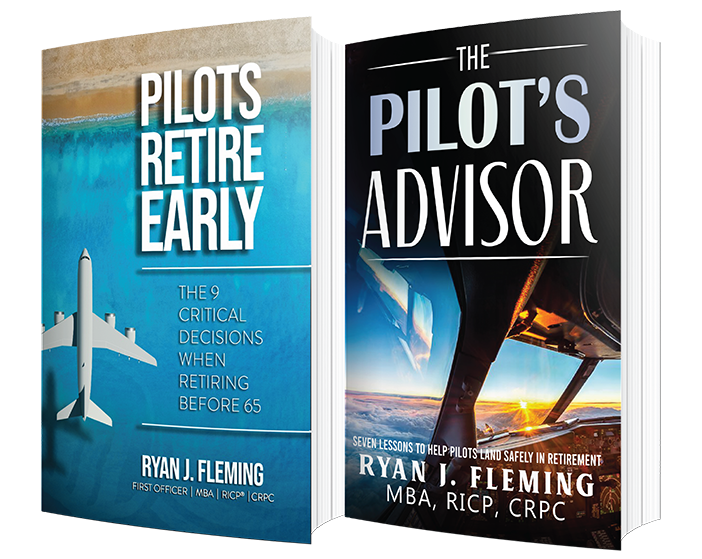
Attention, aviators, when you’ve spent years in the cockpit managing the complexities of flight, isn’t it time you navigated your retirement with the same precision? Introducing retirepilots.com. Write, right at your touchdown zone on our homepage, there’s a beacon flashing. Get my free toolkit. Click that and you’ll be cleared for a direct route to Ryan’s retirement toolkit, tailor made for pilots like you. Inside, you’ll find two of his important works, the pilot’s advisor and pilots retire early. Between these two books, you can decipher the nine critical decisions when retiring before 65 and discover the seven lessons to help pilots land safely in retirement. But that’s not all. This toolkit is packed with altitude high value, including extras to get your retirement plans off the runway and light the after burners on your 401 k vector on over to retire pilots.com to grab your toolkit, and let’s embark on this journey together. Yeah, lots of different ways that you can slice that conversation up. That’s another one of those things that just looks looking how it fits into your overall. Financial plan. You know, can you use your mortgage strategically in some of these ways? And, yeah, maybe that 50 Year option opens up some unique strategies for folks that otherwise wouldn’t be there.
Ryan Fleming 10:09
So another, another way to think about it too, is everybody wants to pay off their their mortgage, but think about Elon Musk. I mean, if he wanted to go pay cash for a house, he could pay cash for her house all day long, but he doesn’t, because it doesn’t make financial sense, taking out a mortgage from the bank. Yes, the bank’s going to make money. They’re going to, you know, you’re going to pay some interest over time, but it’s the principle of leveraging your assets. You’re using other people’s money to make money. You’re getting into that home, but you can still use your assets somewhere else. So think about that. You know, you got these multi billionaires that can pay cash for everything, but they don’t, because it doesn’t make financial sense.
Walter Storholt 10:49
Yeah, all good points. Ryan. All right, let’s move away from the mortgage conversation and talk about risk. The common question, or the basic one, is, how can I avoid it? How can I avoid risk that’s nice and simple and straightforward, but should we complicate it slightly more for a better answer?
Ryan Fleming 11:03
Well, I don’t think there’s anything in life where you can avoid risk. I mean, if you, if you want to avoid risk altogether, you can’t walk outside your door today, right?
Walter Storholt 11:12
There’s even risk in being sedentary and sitting at home, right, even literally away from it.
Ryan Fleming 11:17
Yeah, maybe you take the risk to make it to the gym so that you might live a little bit longer. But, yeah,
Walter Storholt 11:23
remember that those movies final destination, and the guy, the guy trying not to, not to die out in the world, locks himself in a room, and then he realizes there’s still, like, 1000 ways he can die just sitting there in the room as the winds blowing things. You know, it’s, it’s one of those kinds of things.
Ryan Fleming 11:36
There’s always so the better question, how can I take the right amount of risk for my situation, for my goals, and the right amount of risk for my time horizon. And I say time horizon on purpose, and the reason why I say that is everybody, as they get closer to retirement, they want to totally reduce their risk based off of their age, they feel like, Oh, I’m almost 65 or I’m almost retired. I need to drastically reduce my risk. And it has nothing to do with your age. It has everything to do with your time horizon for that money. And this is a common conversation, conversation I’ll have, and we’ll say, a FedEx pilot, okay, I have a FedEx pilot that’s going to get a full retirement from FedEx. Oh, by the way, he also retired from the military. So you have a FedEx pension, you have a military pension. We haven’t even talked about Social Security, and they want to start reducing their risk on their 401, K. And I go, so how much income do you need off of your 401? K in retirement? And we have some conversations, look at numbers like, Well, none. It’s just going to continue to grow. And I go, okay, so your time horizon on this 401, K is way off in the distance, so you just want it to stop making money for you. You want to pull the throttles back and just bury it under your mattress now. And that doesn’t make sense, right? Because it’s not your age, it’s your time horizon or another one that I’ll talk about because I, you know, I see this stuff all the time, and it bugs me. My father in law, and he’s got, you know, the money has saved, and he’s got a pension, he’s never going to use it, never going to use it. So why do we have it sitting in CDs? If we want to pass it on to the grandkids, why not let that money grow? Because your time horizon for that money is never right? You don’t need it for income. So let’s, you know, take on more risk, let it grow. Then the grandkids could have better education, better life, whatever, you know, whatever his goals are. So I see this all the time, and so what I talk about risk, we really need to look at a time horizon and what those goals are. Yeah, that money could be get off my soapbox. Sorry about that. I’ll get off my soapbox. I get
Walter Storholt 13:42
just getting on your soapbox. So no worries.
Ryan Fleming 13:44
Get passionate every once in a while, and this is one of the one bugs me.
Walter Storholt 13:48
Yeah, all right, last second. Last one. When markets get topsy turvy, people want to move to cash. They want to flee. So they say, Hey, should I should I do that? Should I move everything to cash? When the market is going crazy, and wait until it settles down. If we’re having a soapbox, I know this is one that you could stand on all day, right?
Ryan Fleming 14:07
Yeah, trying to time the market. And I get these questions all the time, oh, the government shut down right now, and we obviously the market’s doing this or doing that. If we knew what the market was going to do, absolutely go to cash whenever you want, and then go perfectly, right back in. But that’s not the way it works, because nobody knows what the market’s going to do, and the market is actually completely unpredictable, and your time in the market is probably going to be your biggest determinant of how much your money grows over time. So the people that are trying to time the market hurt themselves way worse than they would have if they just stayed in the market, had a diversified portfolio for their risk tolerance and or had a system to reduce exposure. A little bit unemotionally, I think that this is a huge problem with many, many investors, where they they make short term. Some emotional decisions based off of what’s going on in the news. And I like to call it the short term chop, like, I like to think about water or even, or even a chop like turbulence in an airplane. I mean, if you’re flying an airplane and all of a sudden we hit a little chop or turbulence that we weren’t expecting, we don’t just jump out of the airplane. No, you ride it out and you still continue on to your destination. And I think the same thing applies with investing. We’ve built out a portfolio that’s designed to handle that short term chop. So don’t make a short term emotional decision with that little bit of topsy turvy chop. Let’s focus on the long term. I mean, I’ve had pilots that are 28 years old that are worried about the short term. I’m like, You’re 28 years old. This money’s in a 401, K that you can’t touch until you’re retired, most likely 65 this is just noise.
Walter Storholt 15:53
Who cares? Yeah, you know, think about all the ups and downs you’re going to go through before you even touch that.
Ryan Fleming 15:58
Yeah, this is a buying opportunity. And, and currently, and I don’t know when this you know when this will actually be played, but a four to 5% pullback in the market, in most cases, is a very, very healthy thing. When the market’s been doing very well, and you have a four to 5% pullback, what that really does is solidify some of those gains, and we’re still right around where we want to be on a 50 day moving average, all the analytics on the HCM byline are showing positive. So many times when an investor starts getting a little bit nervous and wants to get out of the market, it’s a time when you should get your checkbook out and start buying again, because the market’s still very healthy. It just had a nice little pullback. And you know, you should buy some stuff, or, as they all say, buy the dip. So anyway,
Walter Storholt 16:42
since we don’t know when people will be consuming this material, necessarily, Ryan will throw the usual disclaimer out there, if that’s not exact investment advice, make sure you actually have a conversation about your plan in the proper context and the timing and all those kinds of by now. By now. So as of right now, Ryan’s got a couple of good comments. Yeah, if you’re watching this in 2026 we might be in a different week, in a different conversation, so well.
Ryan Fleming 17:05
And also, you know, I remember the question out there, you know, when’s the best time to panic? And of course, the answer is, never. You should never panic with investing. But if you have an investment plan or you have a system in place that’s unemotional, that’s how you’re going to win. And this is another whole aspect of investing right now that I think has changed. I mean, it used to be, you know, you buy a bunch of low cost passive ETFs, very, very diversified all around the world, and you let it just do its thing. Well, the game has changed. I mean, that’s the way it was back in oh eight when I got in the business, but now with automated trading, I mean, I think 80. I think it’s 85% of all the trades now are instantaneous and made by computers with AI, with technology algorithms out there that are analyzing all this data, you need to have access to a system that instantaneously helps you make decisions, reduces exposure, or hits the throttles and leverages a little bit. I think, if you’re in a passive strategy, just via the numbers, you it’s, I’m not saying you’re going to lose all your money, but, but the game’s changed a little bit. And the last thing I’ll say about that is, in the early parts of 2025 when the tariffs came out, you know, tariffs hit, and all sudden, you know, all these computers made trades, and then all the retail investors, you know, sold too, and we had the fastest 20% sell off that we’ve had in the last 75 years. And everybody kind of started looking at each other, going, what just happened? And looking back on it, the computers made a big sell off, and then it just everybody followed suit. And it’s just scary to see how computers and automated trading can affect the market so much like it did earlier this year. So we have to learn some lessons from it.
Walter Storholt 18:58
Yeah, absolutely great. Wrap up there, Ryan, and leaves us with some parting things to think about again, if you have questions, like what we’ve talked about on today’s show about your retirement plan, your finances, the best next step to take is to get Ryan’s retirement toolkit specifically built for pilots to better prepare for your financial future. You can get that by clicking the link in the description of today’s show. Get the toolkit that not only comes with Ryan’s books, some great resources and other information, but also gets you that free portfolio analysis so you can see where you stand right now, where you need to go into the future. What are the gaps in your plan? What are the key questions that still need to be answered? And so much more. Again, get that toolkit for free. In the description, we have a link. Click that order the toolkit, and you’re on your way. Ryan, great breakdown of all this today. Appreciate the conversation and have a good rest of
Ryan Fleming 19:47
your week. Sounds great. Walter, appreciate you as always, and try to get a little bit of sleep with your new newborn baby son.
Walter Storholt 19:53
Yes, sir, will do take care everybody. We’ll see you next time on the pilots. Advisor, congrats. You.
Speaker 1 20:02
Information is for illustrative purposes only and does not constitute tax investment or legal advice. Always consult with a qualified investment legal or tax professional before taking any action.
This podcast episode is for educational and informational purposes only. The opinions expressed are those of the speaker as of the recording date and are subject to change. This content does not constitute personalized investment, tax, or legal advice. Please consult a qualified professional before making financial decisions.