Preview of what we’ll cover today:
🤝 Social Connections: Work provides built-in community
🏠 Home Transition: Retirement changes daily routines
💪 Healthy Habits: Structure supports better discipline
📋 Plan Doubts: Uncertainty delays retirement decisions
⏳ Early Planning: Start years before retirement
✈️ Pre-Flight Planning: Preparation reduces future stress
Subscribe On Your Favorite App:
 YouTube
 Apple Podcasts
 Spotify
 Amazon Music
 iHeartRadio
 TuneIn
More About This Episode:
More people in their 60s and 70s are staying on the job than ever before, and it’s not always about the money. Ryan digs into the real reasons retirees keep showing up to work. Working longer isn’t automatically the wrong call. Sometimes it’s exactly right. The real question is whether it’s a choice or a fallback. That’s worth figuring out before you assume the answer.
Go Deeper Into The Episode:
0:00 – Intro
0:42 – Why Retirees Keep Working
1:31 – Social Connections
4:00 – Changes at Home
5:13 – Health & Discipline
8:18 – Doubting the Plan
10:58 – Pre-Flight Planning
12:37 – Risks of Not Being Prepared
Resources:
Retire Pilots – https://retirepilots.com
Get your FREE Retirement Toolkit – https://bit.ly/3ZmZsaX
Pilot Tax – https://pilot-tax.com/
The Pilot’s Advisor Podcast is also on video. Watch & Subscribe on YouTube: https://bit.ly/3EIEBW2
Connect with Pilot-Tax: https://pilot-tax.com/
Episode Transcription:
(Note, this is an automated transcription. Please forgive any errors.)
Walter Storholt 0:00
You know, many people in their 60s and 70s are staying on the job, and more people are doing it than ever before. And it’s not always about the money. We’re going to dig into the real reasons why retirees keep showing up to work even past the date where they have to. We’ll talk about it with Ryan coming up next. So, why people keep working into the years that are supposed to be their retirements? Welcome to the Pilots Advisor. I’m Walter Storholt, alongside the Pilots Advisor himself, Ryan Fleming. Ryan, good to be with you this week. What’s going on, my friend?
Ryan Fleming 0:35
Not much, Walter. It’s always good to you know be on the podcast here with you. You know this whole topic I think is very interesting because I I would say that investors have no clue how much they truly have to save to retire. I do believe that that they don’t they don’t realize how much they actually have to save, taking into account taxes and and inflation and all those other aspects of it. However, I totally get so so many people are working because they have to, but there is a large aspect of the population, in my opinion, that are out there for some of the reasons we’re going to talk about, which is just to to have purpose in life and to actually have a reason to wake up in the morning. Unfortunately, I get to watch pilots retire, and some are do a great job with retirement, and then there’s others where it’s not good at all. And so this, I think this this topic will be good, and we’ll talk about some of those things.
Walter Storholt 1:29
Yeah, we’ll hit this from a couple of different angles, and I’m sure this is going to resonate with different people. We’ve kind of got four main categories to hit, although as we zero in specifically to the pilot world as well, I think there may be a few more that kind of bubble up to the surface. The first one that comes to mind that’s definitely not in that money category would be those social connections in the workplace. I mean, not only do people identify with work, but that’s where they have all of their interaction. Their friends are all in the workplace in many cases, and you shut that off, and it gets a lot harder to stay in touch with people harder than you think. I would imagine,
Ryan Fleming 2:04
absolutely. And I think this is very huge in the airline industry. I mean, when I was flying all the time, you see people all the time. I mean, I hate to say bro network, but that’s kind of what it is. You’re seeing all your old friends. It’s kind of like being in a flying squadron, or you’re flying around the world, and you know have layovers in Paris, Hong Kong, Dubai, whatever it is, and hang hanging with the your the people you fly with. It’s a lot of fun, and so retiring from that, it’s. I mean, there’s many guys I’ll never ever see again, or as I’ve flown less and less because I don’t have time. I mean, I miss I miss doing some of the things I got to do, and so it is a hard stop at 65 being an airline pilot. Well, guess what? Now suddenly you’re retiring. I joke and tell guys that their spouse doesn’t like them that much. You know, you get you get twice as much spouse for half the pay, and so you got to ease into that. But but in many cases, I don’t think it is. They don’t need the money, but there’s they got to get into some some other social aspect. I think pilots, some of the stuff that they do is maybe you know flying out at the local FBO, or a lot of them are golfers, so you know get into the golf. But just having some sort of a club or some sort of social interaction would help.
Walter Storholt 3:23
Yeah, you can imagine just how difficult that becomes, and yeah, maybe that’s a reason to transition into retirement rather than the cold turkey. You know, learn learn just how hard that transition is going to be.
Ryan Fleming 3:32
And to your point, though, I would say I would say there are there is an aspect of people that have to work into their 70s because of money issues, but I think a lot of it might be healthcare. Healthcare is one bridging the gap from 60 to 65 or even beyond, and and so there might be a little bit of money worries. But I’d say for the most part, it’s probably not. It’s probably that interaction. It’s probably social interaction and insurance.
Walter Storholt 3:58
Okay, yeah, we’ve hit a couple couple of different things, right? Social connections in the workplace. Yes, some money worries, but our main focus today is kind of a little bit on the outside of that. Avoiding change at home, I think, is a great one that you brought up. We’re talking a little bit about spouses and maybe not wanting you home all the time, or how are you filling those hours? Are you going to be able to just golf every day if that’s what you’re interested in, what’s the financial impact of just doing now five rounds of golf a week instead of maybe just your usual Saturday round or something like that? I mean,
Ryan Fleming 4:30
and for an airline pilot, yeah, that spouse has had their own life for half the month for the last 30 years. So
Walter Storholt 4:36
yeah, it
Ryan Fleming 4:37
is interesting. I’m traveling a lot. I’m in Ubers a lot because I do use Uber to get to and from the you know the airport or or the hotel or whatever, and I’m amazed at how many people are have a full time job and they’re doing Uber for extra cash, or they’re retired and they use Uber to get out of the house or they’re you know just to do something or so their spouse doesn’t kill them so. I think that is a an actual thing, especially with Uber. I think it’s one of those one of those few jobs out there that’s extremely flexible, so you can go make some extra cash and have some purpose out there.
Walter Storholt 5:12
You know, I think about with having a pilot in the family and having these kinds of discussions over the last several years. You guys also, when you’re flying and and flying heavily, a heavy schedule, you have to have a really disciplined style of taking care of yourselves because you’re always on the road, you’re always living out of a bag. You’ve got to be able to work out in a variety of places if you’re trying to stay healthy. You’re trying to eat healthy on the road, but often you know having the opportunity to be eating out all the time and getting together with guys, and now you go to this like permanent home life, and a lot of those things that made you successful throughout your working career from a habit standpoint, I would imagine there’s a period of adjustment that you have to go through when everything’s now based from home and not on the road.
Ryan Fleming 5:58
I think doing it at home’s probably Easier personally, but then I also go back to where it’s easier to have that routine on the road because it’s you know it is a very hard lifestyle. It’s not good for your health. It’s hard to eat healthy on the road, but there’s also that aspect of okay, now I’ve landed back to the hotel, and then you always know it’s I got to work out and I got to eat. You know, like this, those, you know, it’s not real, real complicated. But we joke and call it living the dream because it so much is, you know, you’re in a metal tube for half your life, multiple time zones, which aren’t good for your your body, sleeping in some random bed, you know, all over the world, and then trying to fit in a you know getting your steps in or going to hit the gym, and then where are you going to get your next meal? I mean, it it is a tough lifestyle, which you know obviously I can relate to doing that. And I know what is it? It was your brother-in-law that’s a Delta pilot.
Walter Storholt 6:58
Yes.
Ryan Fleming 6:59
Yeah. Yep. No. So it is. I mean, it takes some some discipline and transition work, even depending on what airplane you fly and where you’re going, what countries you’re going to.
Walter Storholt 7:13
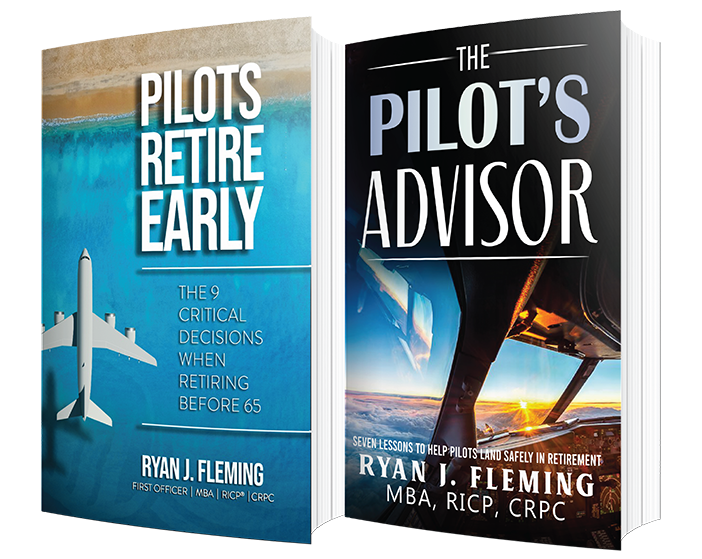
Attention, aviators! When you’ve spent years in the cockpit managing the complexities of flight, isn’t it time you navigated your retirement with the same precision? Introducing retirepilots.com. Right at your touchdown zone on our homepage, there’s a beacon flashing. Get my free toolkit. Click that, and you’ll be cleared for a direct route to Ryan’s Retirement Toolkit, tailor-made for pilots like you. Inside, you’ll find two of his important works: *The Pilot’s Advisor* and *Pilots Retire Early* Between these two books, you can decipher the nine critical decisions when retiring before 65, and discover the seven lessons to help pilots land safely in retirement. But that’s not all. This toolkit is packed with altitude-high value, including extras to get your retirement plans off the runway and light the afterburners on your 401k. Vector on over to retirepilots. com to grab your toolkit and let’s embark on this journey together. Well, there’s certainly one other reason, and it sort of bridges the gap between money and a non-money reason, and it’s more about the plan. And that’s people who just doubt their plan. They may think they’ve got enough money to retire, could probably do it. Maybe they’ve even got the social things figured out and the routines, and the spouse is okay with them being home a little bit more often, and they’ve worked through those kinds of issues. But they’re starting to doubt their plan, and that’s what keeps them working beyond when they have to.
Ryan Fleming 8:45
And I think that’s twofold. I one of my books, Retire Early, talks about how it takes. You could actually probably retire early. It just takes a lot more planning early on that a lot of pilots aren’t very good at. And we’re not talking like a year or two out. We’re talking starting to plan in your 40s and 50s to make sure you’re covering all those bases that you need to cover to actually walk away early, and and unfortunately pilots aren’t very good at covering all those bases. I mean they they know that they have to save for retirement, so they max out their four 1k and do those little things. But there’s certainly a lot more that goes into it when you start looking at how the distribution phase of retirement works and healthcare and and stuff like that. But I do think that a lot of people continue working because they’re unsure. I mean, I have a lot of clients that actually are retiring and they they’re freaking out, thinking they’re in a bad spot. And once we really have our meetings and develop a retirement income plan, and I sit down and show them the numbers of like truly what what their budget is and and how much how many assets they have saved and looking at the taxes and inflation and and they’re like oh I’m pretty good aren’t I and I like yeah you’re fine you’re fine it’s good so. I enjoy those times where I can put them at ease and tell them that they’re going to be just fine and go spend money, go vacation, enjoy those go-go years. It’s tough when I have somebody that’s getting right at that retirement point and things aren’t good, right? So I would only say that to say, call me. Let’s start planning early. The earlier you plan, the better off you’re going to be. And I find it-I mean, almost to 100%-that the do-it-yourselfers that reach out at 60 or you know close in their 60s, we’ll say, are so far behind on some of the things they they need to do, and it’s like they’re bringing you a a pile of mess, like okay, I’m finally here. I’ve never talked to an advisor before. Can you help me? And it’s like, man. And and if I had $1 for every single time I hear, God, I wish I would have called you 10 years ago. If I had $1 for that, I’d be retired. I’d be a I’d be a multi millionaire.
Walter Storholt 10:57
Yeah, I kind of think of it this way, Ryan. You know when you’re when you’re in your mid 60s to 70, essentially when you are retired, you’re in the air, and so if you have a problem, it’s really severe at that point because you may have to come back and land, you may have to turn back around and go to your original airport. These are not fun things. These are not good things, or you’ve just got a major issue in the air and you’re crash landing. If you can discover a problem when you’re in your early 60s, maybe even late 50s, you’re on the tarmac, but it’s not as severe as being up in the air. And if you’re addressing problems in your earlier 50s or anywhere before that, hey, it’s before the passengers have boarded the plane. We’ve got time to fix issues and and get everybody out on time and still make everything work. So I kind of think of it that way. Of like, the earlier you start, the less you are going to run into those problems.
Ryan Fleming 11:44
First off, I’ll say that’s an amazing analogy. We talk we talk about that in like you know pre flight planning. That like if you can get this stuff set up at ground zero when the plane’s not moving, so much easier. And I always joke that I’m not a very good pilot, so I always try to stack the cards in my favor, you know. Getting all that stuff, all those briefings, looking at the approaches before you even go, you know, because it makes everything so much easier. I mean, if you’re a pilot and you’re not doing something, you’re wrong. And so, you know, many pilots get behind the airplane because of that. And so, you talking about that that hits perfectly. You know, doing that pre-flight planning, so you know before you even step to the aircraft, and you have all your bases covered. Same thing with retirement. Start that in your 40s and 50s, and by the time retirement comes around, you you’ve been prepared for it for years, and there’s no surprises. And so I love that.
Walter Storholt 12:37
Has anyone ever regretted being more prepared? Like, oh, I over prepared. I didn’t have to prepare this much. Like that would be a pretty rare thing, right?
Ryan Fleming 12:45
It’s so much being on that other side. You know, you want to be operating at L over D max and being right where you’re supposed to be. And I think that the people that that look at this stuff early on, there’s it takes all the stress away. It takes all the stress away that we’re talking about versus those people that don’t plan, and what what I hate is for some reason pilots like to kick the can down the street. They like to ignore it. They think it’s just going to go away, and it’s not. The problem is going to get worse. And so, why one of the most important things in your life you don’t address early on and come up with solutions and planning for it, I don’t get. And even investing, investing’s not hard. It just takes discipline, and it takes taking the emotion out of it and showing up every day. Right, consistency.
Walter Storholt 13:32
Yeah.
Ryan Fleming 13:33
And if you have those things, investing is easy. Being disciplined, being consistent, be unemotional. You’re going to win. But can lead a horse to water, but you can’t make them drink, right, Walter?
Walter Storholt 13:44
Absolutely. I think the moral of the story here is: don’t assume that you have to just keep working. Look into the reasons. That all starts with the planning process. But also recognize that the plan is more than just the money. It’s about what you’re going to do with your time, how you’re going to have purpose in retirement. Make sure all those things work in concert with one another, and you’re going to be way ahead of everybody else who’s just flying by the seat of their pants when it comes to retirement planning. So, if you’d like to talk with Ryan a little bit more, if you’re a pilot and you’re wanting to do the best planning you can do to get ready for retirement and all of the things that are involved in your financial future, best way to get in touch is to get that retirement toolkit. You can order it by clicking the link in the description of today’s show. That comes with a free portfolio analysis, where you’ll be able to meet one-on-one with Ryan and talk about the specifics in your situation, and that’s really important too. We need custom guidance. We need custom plans put together for your situation, and that’s what you get when you work with Ryan at the Pilots Advisor. So check that out again. Link in the description of today’s show for those who are interested. Otherwise, hope you enjoyed the content. And Ryan, we’ll talk to you again next time.
Ryan Fleming 14:50
Sounds wonderful. And I think some of the things we’re talking about is about building building good habits, good habit patterns where you you know you just your instincts take over. So we’re going to work on this. I’m trying to. Work with Walter here for a little while about you know pilots and checklists and and you know standard callouts and stuff like that. So we’re gonna we’re gonna try to end this episode. Paul, you ready? You ready for this, Walter? I know you’ve been ready for this. If I said positive rate, what what’s the pilot going to say?
Walter Storholt 15:16
Gear up.
Ryan Fleming 15:17
There we go. Positive rate.
Walter Storholt 15:20
Gear up,
Ryan Fleming 15:21
set max power. Let’s go.
Walter Storholt 15:23
See you next time.
Speaker 1 15:29
This episode is for educational purposes only and is not individualized investment advice. The Pilots Advisor LLC is an SEC registered investment advisor. Registration does not imply a certain level of skill or training. Past performance is not indicative of future results, and investing involves risk, including the possible loss of principal.
Transcribed by https://otter.ai
This podcast episode is for educational and informational purposes only. The opinions expressed are those of the speaker as of the recording date and are subject to change. This content does not constitute personalized investment, tax, or legal advice. Please consult a qualified professional before making financial decisions.