Preview of what we’ll cover today:
💸 Retirement Taxes: Many retirees underestimate taxes in the distribution phase
🧾 Tax-Deferred Reality: 401(k) withdrawals count as taxable income
📉 Withdrawal Taxes: Large income needs can create major tax bills
🧠 Tax Planning Myth: Smart strategies aren’t just for the wealthy
🟣 Roth 401(k) Confusion: Many investors misunderstand contribution rules
Subscribe On Your Favorite App:
 YouTube
 Apple Podcasts
 Spotify
 Amazon Music
 iHeartRadio
 TuneIn
More About This Episode:
Nobody likes tax season, but for new retirees, the rules can feel completely different. Income changes, required withdrawals begin, and decisions that once lowered taxes can create bigger bills later. Ryan unpacks some of the most common retirement tax mistakes and how they show up in real life. A little forward planning can make a dramatic difference over the long run.
Read The 5 Biggest Tax Mistakes New Retirees Make in the First 5 Years
Go Deeper Into The Episode:
0:00 – Intro
1:07 – Tax Season
2:26 – Tax-Deferred Money
3:17 – Tax Planning is For Everyone
4:45 – Ignoring Upcoming RMDs
8:12 – Roth Conversions
11:38 – Social Security Taxes
15:52 – Legacy & Estate Planning
Resources:
Retire Pilots – https://retirepilots.com
Get your FREE Retirement Toolkit – https://bit.ly/3ZmZsaX
Pilot Tax – https://pilot-tax.com/
The Pilot’s Advisor Podcast is also on video. Watch & Subscribe on YouTube: https://bit.ly/3EIEBW2
Connect with Pilot-Tax: https://pilot-tax.com/
Episode Transcription:
(Note, this is an automated transcription. Please forgive any errors.)
Walter Storholt 00:00
Well, nobody likes tax season, but it’s upon us again, and it’s got us thinking about new retirees, folks who maybe have just retired in their first couple of years, especially in that first year of retirement, or if you’re on the cusp, this is a great episode for you as well, because there are some tax mistakes that specifically new retirees tend to make that caused some issues, and we want you to avoid issues. We want you to avoid mistakes when you get into retirement. So we’re zeroing in today. We’re talking about tax mistakes that new retirees make, and how to avoid them. I’ll grab Ryan, let’s get started. All right, tax mistakes that new retirees make. Our focus today. We got a couple of good bullet points to give you on the episode today, some things to think about. Ryan, good to be with you again. How’s life treating you?
Ryan Fleming 00:47
My friend? No complaints. You know, it’s March now. Things are slowly starting to warm up here in South Carolina, but it is tax season, yes, and everybody’s talking about taxes, and we’re going to, you know, dive into the beautiful thing that the IRS has created for us and talk about what taxes look like in retirement. Some of the things you should start thinking about,
Walter Storholt 01:07
how busy do you get during tax season? Because I know you’re not, you’re not a CPA, but like, you’re a financial advisor, right? So taxes are a big piece of the overall planning puzzle. But like, how big is that deadline each year for you from a planning perspective?
Ryan Fleming 01:19
Well, first of all, you’re right. I am a financial advisor. I am not a CPA, and I do not give tax advice and whatever else disclosure you
Walter Storholt 01:27
need to be what other disclaimers do we need to throw out?
Ryan Fleming 01:32
But no, I mean definitely, around tax season, things get a lot more that definitely get more busy, lots of questions. Working directly with the CPA. Work with Zach Smith at pilot tax a lot, almost daily, just making sure that we have the correct tax documents for our clients. But I think that we’ve done a really good job with our podcasting and everything else to get the message out there about taxes. Because yes, saving for retirement, having a proper asset allocation, being diversified, you know, not time in the market, all those things are out there, and once you have that done, well, tax planning is a massive, massive portion of this, and I think that there’s a lot of investors that are very much caught off guard getting into the distribution phase of retirement and not realizing how massive of an effect the lack of tax planning is going to have on their retirement. Picture. Yeah, it’s a great point. It’s really sad, actually. I mean, yeah, one of the biggest ones I would say, you know, I know we’re about to talk about RMDs and some other stuff like that, but it amazes me that investors don’t understand when we talk about tax deferred Money, money that their companies put in, money that they put pre tax into their 401, K, they don’t understand that they still have to pay income tax on that. And it’s amazing to me how many of them get into retirement and they’re like, oh, I need a, you know, I need 10 grand this every month. We’ll set we’ll call it 10 grand every month. And then they don’t realize that, you know, that’s $120,000 of income over the course of the year that they’re getting, but I don’t know, maybe 25 30% of that they got to pay a tax bill on. Yeah, and they’re like, What? Like, yes, we’ve been saying this all along.
Walter Storholt 03:13
Yeah, this wasn’t one of the things on the list. But before we get into the official list, since you brought one up, I’ll point out another one. I think a big mistake people make is just not realizing maybe how effective planning for taxes can be. They just kind of miss that opportunity, or they assume maybe that they don’t make enough to be in that category of person who can move the needle dramatically with tax planning. That’s only for the super rich. I feel like that’s a common misconception that people have where everyday folks can take advantage of the tax code and make make really important decisions that save 1000s, 10s of 1000s, in many cases,
Ryan Fleming 03:48
absolutely and or how many people out there are missing out on all the opportunities that have been given to them? It’s really, really sad, but I’ll get a lot of prospects that reach out to me and they haven’t been taken taken advantage of Roth contributions in their 401, k, for years, for a long, you know, a long, extended period of time. And the answer wasn’t, of course, this is the do it yourselfers. But their answer was, whoa, I’m an airline pilot, and I thought I made too much money to contribute to Roth. And it’s like, well, yeah, that’s a Roth IRA, which is completely different from a Roth 401, K, yeah. I mean, that that alone is such a massive, massive tool, and thing that will help you in retirement and to miss out on that for an extended period of time is, I mean, it makes me sick to my stomach, yeah.
Walter Storholt 04:39
Well, there’s our own starter list, the rest of the list,
Ryan Fleming 04:42
this list you were talking about, yes, the rest of the list,
Walter Storholt 04:45
to give credit, where it’s due, is from a Kiplinger article. And so we’re just going to kind of get Ryan’s reactions to these things. To say, Yeah, are these really tax mistakes that new retirees make, or is this overblown? But hey, we kind of added our own nice little addendum here to the beginning. The first thing that was made. In this particular article, Ryan was that it’s a mistake for new retirees, kind of counterintuitive, but to ignore upcoming RMDs, so I just retire, let’s just say somewhere in my 60s, right? And you’re saying it’s a mistake to not be planning for something that I have to worry about until I’m in my 70s. But that’s often the case, I guess,
Ryan Fleming 05:19
for sure, but you know, I’m going to require a short coffee break on this.
Walter Storholt 05:24
Doo doo doo doo doo doo doo doo. We have a little coffee music we can play in the background
Ryan Fleming 05:30
much better. So it’s one of the first things I think of once we go into retirement. However, depending on when you actually retire, throughout the year, let’s say you retired in October, well, you still had your normal income that almost that whole year. So you’re really not in a space where you’re in that lower tax bracket that we were hoping for. So the first thing I would say is, depending on when you retire from the airline, is actually going to have a little bit of effect on what I start thinking about from a planning perspective. But that first year after you retire, your income, your tax bracket is going to be totally determined by how much money you take out of your 401, K, how much you’re taking with Social Security. So you have a little bit of control of your tax bracket for the first time. That should should be lower than what you’re doing while you’re actively working. So what does that bring up? Well, we have an opportunity now to do something about that massive balance that you’ve been saving all this time. Now, I hope we don’t have to talk about what RMDs are. But since Walter, so, so intelligent Walter, why don’t you tell us about RMDs? What are RMDs?
Walter Storholt 06:35
Well, that’s the required minimum distribution, basically the government saying, Hey, you have a lot of money in your retirement account. So when you get into 73 or 75 depending on when you were born, these days, we’re going to make you take that money out so that we can start collecting taxes on it. So whether you need it or not, you’re taking that money out.
Ryan Fleming 06:53
Yeah, the government has been giving you tax deferred growth this whole time, and they’re, they’re ready for you to pay up. Yeah, give them their give them their cut. And so what we want to do from the time you retire, and we’ll say 65 to 73 and I think it’s 73 is the age if you’re born between 51 and 59 if you were born after 1960 then it’s 75 and keep in mind, those are probably changed by the time you get there. If you’re a little bit younger, because they keep backing up a little bit, but you have, you have a little bit of a window to take advantage of that and try to either take some of that tax deferred money as income, you know, to live off of, or move it somewhere. Because what we’re trying to do is we’re trying to lessen that ticking tax time bomb that we talked about, where once you hit that age, depending on how big your 401 k is, they’re going to make you take it out, whether you want it or not, so whether that’s Roth conversions each year a little bit. And there’s a lot of strategy that go into that goes into like that playbook, which we might even be able to have a whole separate podcast on that. But yes, do not ignore RMDs. Do not wait till 73 Do not wait till 75 as soon as you retire, talk with your financial advisor, talk with your CPA. Come up with a game plan to lessen that tax hit for RMDs, or else you’re going to have a rude awakening and not be very happy.
Walter Storholt 08:14
Well, that one is very closely tied to Roth conversion, since you started bringing it up, and that’s point number two is a big mistake retirees new ones make is Roth conversions that are done wrong or not at all. That’s one of the big levers you can pull to plan for those RMDs, but other purposes and uses for why you might want to do Roth conversions early in retirement as well and not wait till later on to be kind of forced to do some of those decisions well.
Ryan Fleming 08:39
And this is a double edged sword, too. I mean, I It’s amazing. I’m starting to have some of these conversations with people that are younger, which I think is fantastic. You could do Roth conversions right now. You can do Roth conversions in your 30s, 40s, 50s.
Walter Storholt 08:51
You don’t have to even wait till those first years of retirement, right? Yeah, the
Ryan Fleming 08:55
one thing I you know, and yes, you might be in a higher tax bracket because you’re actively working, but what you’re doing is you’re effectively taking whatever money you convert, and then you’ll never, ever owe tax on it again. So let’s say you are 40 years old. Well, now you got growth for the next 25, 3040, years where you don’t owe the government anything. And I love having this conversation, because so many people are like, Oh, but tax deferred is great. I can lower my AGI by a little bit, yeah, but think about what you’re giving up. Because if you are 40, you know, and I’m just going to do some quick math here, I mean, besides your contributions into it growth. I mean, we want that account to grow as much as possible, you know, double, 234, or five times. But what happens with that you just created a much larger tax bill later. So it’s really is a double edged sword, pay me now or pay me later, but the government’s going to get theirs. And so do you want to pay them to go away on a little kernel of corn and then it grows into a harvest? Or do you want that kernel of corn to grow into a massive harvest? And then you give away your 25 or 30% and I think 25 or 30% is hopeful, because I don’t know what tax rates are going to be like 20 years from now, or when you are 75 or whatever that age is, because it’s an unknown. That’s the big unknown. So, yeah, yeah. And so it’s a, it’s a, really, it is a double edged sword, and having tax conversations can be very beneficial, and not only the you know for that growth that could be tax free forever, but this really plays into legacy planning as well.
Walter Storholt 10:33
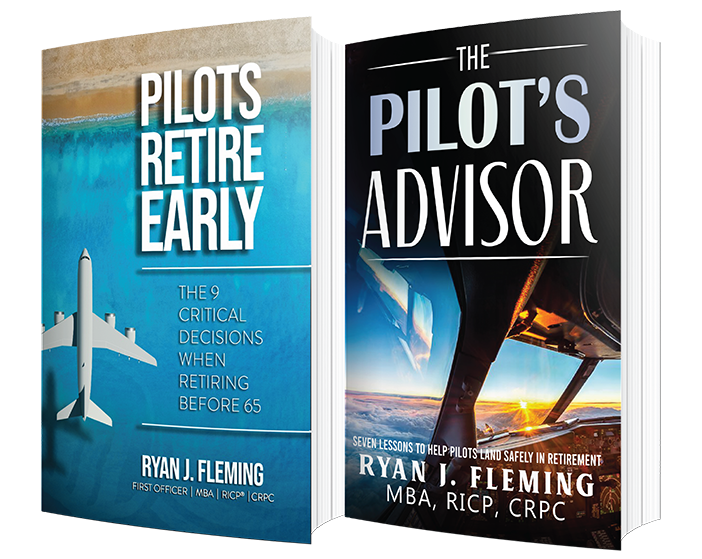
Attention aviators, when you’ve spent years in the cockpit managing the complexities of flight, isn’t it time you navigated your retirement with the same precision? Introducing retirepilots.com right at your touchdown zone on our homepage, there’s a beacon flashing, get my free toolkit. Click that and you’ll be cleared for a direct route to Ryan’s retirement toolkit, tailor made for pilots like you, Inside, you’ll find two of his important works, the pilot’s advisor and pilots retire early. Between these two books, you can decipher the nine critical decisions when retiring before 65 and discover the seven lessons to help pilots land safely in retirement. But that’s not all. This toolkit is packed with altitude high value, including extras to get your retirement plans off the runway and light the afterburners on your 401 k vector on over to retirepilots.com to grab your toolkit and let’s embark on this journey together. I know this is a smaller piece of the puzzle for a lot of your pilot clients, but social security in retirement is another area where we see new retirees make a mistake in that they think that taxes aren’t really a part of Social Security. Of collecting Social Security, they kind of get blindsided by Social Security taxes and how that impacts their overall situation. Do you see that from time to time that misconception, and have to kind of correct some, some line of thinking there.
Ryan Fleming 12:03
I really try to get them prepared for that. I mean, how many people knew that after paying into Social Security their whole lives, that up to 85% of their social security would be taxed in retirement? Yeah, and where it hits people is people with pensions. I mean, if you’re you know, retired military, retired police officer, if you work for FedEx or UPS where they still have a pension, you have enough pension assets that you’re in every single year that you’re getting taxed on that pension, but that income alone pushes it into where your Social Security is taxed as well. Yeah. So I really, I’m not a social security expert, nor do I claim to be in the system is changing so much I think it’s going to be reduced at some point in time. So really digging in and asking the right questions with Social Security and aligning with your situation is definitely something that needs to you know, you need to dig in on. What do you think Social Security Walter is much younger than me. As you guys can talk just by looking I don’t know that much. What do you, you know, I know we talked about not planning for having social security later on in your retirement planning. But like, what do you actually think
Walter Storholt 13:14
is going to happen? Yeah, I mean, personally, I guess I haven’t paid much into the system as a small business owner. You know, taking a much smaller w2,
Ryan Fleming 13:23
what’s that? What’s that knock at the door? Is that the IRS coming
Walter Storholt 13:28
after the the fact, you know, my wife, now, she is in a setup where they have that 401 A, so they’re not paying into Social Security, I guess, anymore, right? Is that how that works? And she has this 401, a instead account. So I think our social security checks, they’re already weaning us off of it. They’re going to be very small in the grand scheme of things, by the time we retire. So I’m kind of planning for basically minimal or no social security by the time we retire. I think a lot of people that are my age are kind of similarly with a pessimistic view that that’s going to be the case for them as well. So if it’s there, great. If it’s not, I’m hoping to be able to, you know, plan around it and without it, as sad as that might be, well,
Ryan Fleming 14:13
and I no different than a 401, K plan where whatever you put in is yours in retirement. Yeah. You know, I know it’s wishful thinking, but they have to get this system to where whatever you pay into Social Security is yours.
Walter Storholt 14:24
You’re at least getting that money back. Yeah, even if it’s not going to be a lifetime payout, at least give back what we put in something like that.
Ryan Fleming 14:32
Something’s got to happen, because I 100% think it’s going to be reduced. It’s not going to go away, because so many people have paid into it, but you have 10,000 baby boomers that are retiring every single day, yeah, that are no longer paying into it, that are now drawing from it. And the math does not add up. And it’s, I mean, it’s, it’s, it’s a sad state of affairs. We’ll put
Walter Storholt 14:53
it that it’ll just keep getting minimized and minimized and minimized until it’s, you know, I mean, that’s better than pulling all. Off the band aid, I guess, right? And having some generation have to take the brunt of it just being fully cut off. So I think you’re right, it’ll just be a very slow reduction of benefits over a long period of time until it’s relatively insignificant that point. And hopefully the younger generations have weaned off of it and had other alternatives by that point, kind of like we talked about with the Trump accounts, right? And those getting seeded early on in life. And if that could become a replacement for social security by an early payment that then has 50 years, 60 years to grow, you know, maybe that’s a better way to go.
Ryan Fleming 15:31
Something definitely has to happen. I mean, no different than I’ve read a lot of books about income taxes and then Social Security. And you know, it is, you know, has been deemed the biggest Ponzi scheme there is out there, and unfortunately, most every Ponzi scheme out there blows up at some point. And we’re just, I feel like we’re watching this slow motion, massive car accident and about to happen. So yeah,
Walter Storholt 15:53
does feel that way? Last but not least, Ryan, you teased it a little bit already, Legacy estate planning, that’s kind of the last thing that we want to talk about, from a tax mistake that new retirees make and forgetting to go ahead and start planning for a lot of people don’t want to quite start thinking about their heirs, maybe and passing money to the next generation. Maybe they view that as a later in retirement thing to think about. But at least, don’t overlook the taking care of the spouse. That’s part of a state and legacy planning, and that does need to be done as soon as possible.
Ryan Fleming 16:24
Yeah, and, you know, we always try to talk about issues that affect airline pilots, and so I’ll bring up some of those. I grew up with very little, and I, for me, Legacy planning, or leaving a legacy has been a huge part of what I want to leave this world with. You know, where I don’t necessarily need all these things in my retirement, but when I when I am gone, I want you know my family’s future to be changed. And one of the biggest mistakes I see is we start having conversations with airline pilots as they get near 60, and they realize the retirements around the corner, it’s going to happen. And so many of them have insurance through the airlines, but that insurance goes away as soon as you retire. Yeah, the other side of it is, of course, insurance is based off your current age and health. So right at the time where people are really starting to think about the true effect of once they retire from the airline, they’re also battling age and issues health wise. So if I could give a shout out to anybody out there, is to start thinking about these issues when you’re in your 40s and 50s, because not only is insurance so so much cheaper, but it can be a viable plan to help you out with retirement planning, to not only take care of your spouse, pass on that legacy, but this plays into how you’re going To look at Roth conversions, RMDs, it all plays together, because you’re going to have a lot more levers, as you talk about to pull from to make sure that your spouse or your family’s taken care of when you decide to retire from this earth. And I don’t know about you, but I knowing that we’ve talked about those things, or at least having those things in place, I sleep a lot better at night knowing that my family is going to be taken care of regardless of what happens to me.
Walter Storholt 18:05
Yeah, well, said, it’s a great goal, and one shared by many. So let’s plan for it and make sure it’s part of the conversation. We’ve just scratched the surface in terms of tax planning conversations. There’s obviously lots more that you can get into when you start working one on one with an advisor like Ryan and going into your particular situation, which is a great point for me to remind folks, if you have not put together an official financial plan before, you know a written plan that’s really designed to get you to retirement and all the way through it, certainly take advantage of an opportunity to meet with Ryan by ordering the retirement toolkit. It’s built specifically for pilots, packed with Ryan’s books, some other great information, all great starter info to get you ready for that official retirement plan, and it comes with a free portfolio analysis where you get to meet one on one with Ryan and the team he is. Of course, the pilot’s advisor works exclusively with pilots across the country, helping them with retirement and financial planning matters. Click the link in the description of today’s show to access that toolkit and get that ordered and set up your time to visit. Or you can always just go to retirepilots.com for more information there as well, but there should be a link in the description of today’s show so you can access that easily as well, and remember tax mistakes they’re not usually made because of carelessness. It’s a lot of time just knowing what you don’t know and finding that out and just getting educated on it, and that’s what Ryan does each and every day with clients. Ryan, thanks for all your help covering these items today. Appreciate the deep dive, and we’ll talk to everybody soon, right back here on the pilots adviser.
Speaker 1 19:39
Information is for illustrative purposes only and does not constitute tax investment or legal advice. Always consult with a qualified investment legal or tax professional before taking any action.
This podcast episode is for educational and informational purposes only. The opinions expressed are those of the speaker as of the recording date and are subject to change. This content does not constitute personalized investment, tax, or legal advice. Please consult a qualified professional before making financial decisions.