Preview of what we’ll cover today:
📊 Portfolio Exposure: Many investors don’t realize how much AI exposure they already have
⚖️ Risk vs Opportunity: AI could drive growth, but also increased volatility
⏳ Early Retirement Thinking: Fear shouldn’t be the reason you retire early
🧠 AI Planning Tools: Helpful for information, but not a replacement for strategy
🚧 Human Element: Emotion, context, and experience still matter in decision-making
Subscribe On Your Favorite App:
 YouTube
 Apple Podcasts
 Spotify
 Amazon Music
 iHeartRadio
 TuneIn
More About This Episode:
AI isn’t just a buzzword, it’s quickly becoming one of the biggest unknowns in retirement planning. Pilots in their 50s and 60s are actively searching for answers about how this technology could impact their future. Ryan tackles the most common AI-related questions pilots are Googling right now, and where human judgment still plays a critical role.
Go Deeper Into The Episode:
0:00 – Intro
0:55 – Will AI Take My Job Before I Retire?
3:42 – Is My Portfolio Safe with AI Stocks?
6:72 – Should I Retire Early Before AI Gets Worse?
11:18 – A Pilot’s Manual Decision-Making
14:39 – Can AI Help Me Plan My Retirement?
Resources:
Retire Pilots – https://retirepilots.com
Get your FREE Retirement Toolkit – https://bit.ly/3ZmZsaX
Pilot Tax – https://pilot-tax.com/
The Pilot’s Advisor Podcast is also on video. Watch & Subscribe on YouTube: https://bit.ly/3EIEBW2
Connect with Pilot-Tax: https://pilot-tax.com/
Episode Transcription:
(Note, this is an automated transcription. Please forgive any errors.)
Walter Storholt 00:00
On today’s episode AI and retirement, we’re going to go through some of the top things that people in their 50s and 60s are Googling about, AI and retirement planning. We’re going to give you some straight answers to these questions that people are asking and see what it kind of reveals about people’s concerns, fears and thoughts heading into kind of this new era of AI and what it’s going to do in our lives. Should be fun. Let me talk to Ryan. We’ll get started. AI is our topic of conversation again today, but a little bit different angle, which should be fun. I’m Walter Storholt alongside Ryan Fleming, as always, the pilots advisor, Ryan. You ready to talk some more AI today?
Ryan Fleming 00:39
Let’s talk AI. It seems to be what everybody’s talking about nowadays.
Walter Storholt 00:43
It is, yeah, it was kind of like the number one story out there before the conflict in Iran started. But now I feel like people are back to talking a little bit about AI. It’s bubbling up, once again, kind of in the news quite a bit. So we’re gonna look at some of these top searches that people are googling or searching about AI and retirement. So this will hit a few different angles. All right. The first one reiterates a little bit of what we talked about on a recent episode. It’s the very obvious one, will AI take my job before I’m ready to retire? This is the big one, right? Nobody wants to get replaced right before they retire. Those kinds of threats have always been there, but AI is just like stoking it even more these days, yeah.
Ryan Fleming 01:21
And we did a whole podcast on whether or not, you know, pilots jobs would go away. And so I think we beat that horse a little bit. But yeah, I think that that it’s a very scary question, because there’s no doubt that it is taking people’s jobs pretty quickly in many different career fields. I mean, I’ve even had people that are very intelligent. People would say you got five years to make money and get invested and buy hard assets, because you you know, maybe half the population is not going to have jobs by then. So it’s really scary to think about.
Walter Storholt 01:50
Yeah, those implications, again, we covered them pretty heavily. At least we feel like for pilots, no, you’re not getting replaced in the next couple of years. So if you’re a pilot in your 50s and 60s, I don’t think you have to worry too much about getting replaced. Now, again, Ryan’s bigger concern, as he outlined in that other episode, is the bigger concern of what happens to the society of a whole and how that maybe impacts pilots. Different conversation, hard to read all of those tea leaves, of course.
Ryan Fleming 02:17
And from the investment perspective, that’s where it really all kind of falls back on each other because, you know, we’re sitting here investing in companies and portfolios that invest in all these different companies. Yeah, how is AI going to affect that? I mean, I I can see, over the next four to five years, massive profitability with some of these companies, and if you do own positions and some of these winners. I mean, I could see some amazing portfolio growth in the short term. But what does that look like in the long term, with many of the other companies failing and, you know, the losers of AI, yeah, because I do think, like analysts, I mean, maybe even the legal profession from, you know, the backside of it, doing the research and everything. Yeah, someone
Walter Storholt 02:59
having to read hundreds of pages of briefs or whatever, you can just have aI parcel it out for you and do that pre research, yeah,
Ryan Fleming 03:04
and you’ll still have to have that lawyer go argue it in court, probably, but so many different positions like that are going to go away. And I look at even robots. I mean, robots being built at we’ll call it Tesla. I mean, imagine Amazon, and how many workers will be laid off because robots can stock boxes, pack, you know, build what have you. So I look at, you know, Amazon or Tesla, or some of those companies that are going to be so much more profitable when you take the human element out of it, because it’s that many more workers you don’t have to pay and don’t have to pay retirement benefits too, and HR and all those
Walter Storholt 03:43
other issues, yeah, until the robots unionize and
Ryan Fleming 03:47
it’s decided to kill us. You know,
Walter Storholt 03:49
that’s right, all right. Well, you hit on it a little bit. Search number two about AI and retirement is, hey, is my 401? K safe with all these AI stocks in it, because a lot of people didn’t realize, I think, how much AI exposure they had when they were just kind of generally, maybe invested in index funds or whatever they had in their 401 KS or work plans. And then we saw that software stock pullback a couple of months ago, roughly 33% down from 2025, highs. So not an abstract question anymore. People saw that kind of exposure and that risk. How do you think about AI concentration risk for someone approaching retirement? You viewed it as, hey, opportunity for huge growth in the future as well. So it’s a dual sided question for sure.
Ryan Fleming 04:31
Well, 100% we’re now, we’re talking about greed versus fear, right? Yeah, almost any tech stock, they’re investing massive amounts of money in AI. And then, of course, because of AI data centers, they need so much energy. Now we’re all, all the way over into the energy sector, and all the
Walter Storholt 04:48
possibility that’s there, you can’t, not be invested in AI, is kind of what I’m
Ryan Fleming 04:53
hearing you say, Yeah, or, you know, there’s, there’s, it trickles into a lot of difference you’re going to have exposure to it, but is that going to be good exposure? Or bad exposure over the long term. I think it could be amazing for a while, and then you have a hiccup. And if you have that much AI exposure, per se, and there’s a pullback no differently than we just watched there, it’s going to hurt a little bit. I was looking at some of these numbers. I wrote some of this down. Morgan Stanley estimated that the services and cyclical sectors most exposed to AI disruption represents only about 13% of the s and p5 100 market cap, but that’s today. I mean, what’s it going to look like next year? I mean, I think what’s really changed, you know, people talk about the S and P and is that true diversification when the mag seven has been driving that thing, yeah, for a long, long time. I mean, that’s, you know, owning seven stocks. Nobody would ever do that, but that’s what many, many people are doing. So I think diversification, rebalancing, getting a lot more exposure to a lot more of spreading out risk is going to be huge, because we want to have exposure to AI, we want to have exposure to that tech, especially if that’s where the money’s going, and that’s where some of these returns are going to be. But the key is not having all your money or not being in us, you know, speculating and gambling with your money by putting leveraged, huge leverage positions in your portfolio, in AI stocks,
Walter Storholt 06:21
you may be way more leveraged in it than you think, and that’s a big concern. Search number three, should I retire before AI makes things worse. Now in the pilot context, this is an interesting run one, right like you tell me about PILOTs when new things come along, new trainings, new inventions, new procedures, new tech that you’ve got to learn, figure out, manage your job, responsibility shift because of it. That’s not new, but I can imagine it’s going to come at a more rapid pace the next couple of years, for a pilot that’s in their 50s or 60s. Could they be starting to look a little bit more like you know what I just want to be done with this? Well, this kind
Ryan Fleming 07:01
of makes me laugh, because there has been massive changes already in the in the aviation career field. I mean, we had these old school guys when I first showed up at FedEx. We’re flying 720, sevens on Steam gages. You know, before they had the whole beautiful glass cockpit layout and the automation was not really great. You know, in the autopilots continue to get get better and better, but you had some of these old, crusty pilots that that couldn’t even learn glass, like a glass cockpit. They’re like, I’m out of here. And then, like, you know, the next thing was the iPad, where we’re getting all our information on an iPad, versus carrying around these huge bags of pubs like we used to. So there’s already been a lot of a lot of that, which makes me kind of laugh, yeah, and, you know, now the new thing is the SNAP Pilot, the set sensitive New Age pilot, you know. Okay, they’re a lot more tech savvy, but they’re very sensitive, you know. So there’s lots of stuff that’s happened, but I look at this is, you know, should I retire before AI makes things worse. I don’t know what making things worse is, that’s a very broad question. But what I know is, I don’t give up. You know, I’m a fighter. I’m not going to just go, oh, AI is going to take over the world and take over my job. So let me, you know, just follow my sword. Now, that’s not me. I’m going to dig in and fight or get, you know, get as much as I can out of my career field while I can. And that doesn’t mean running, running blindly into whatever, but, yeah, just take what’s coming and make, make critical, calculated decisions as AI does change our change our world and our profession, because it will. It is, yeah, if
Walter Storholt 08:41
it is your mindset, though, and you’re in your late 50s, early 60s, something like that, you’re like, you know what? Maybe I just pulled it. Pull the lever on this exit plan a little bit sooner. Let me meet with Ryan and see if I can financially do it. Can I retire right now and be fine and not have to deal with the changes the next couple of years? Get some more time on the beach or with family and friends, and that’s the normal, can I retire early question? And maybe AI drives you there. Maybe that’s your reason for why you retire early? Well, I
Ryan Fleming 09:07
think it actually supports what I say to my clients all the time. And you know, we talk about compounding interest in the power of money and building a snowball early so you don’t have to worry about things later on in life. Yeah. And I would argue, because of AI coming down the pipe, save as much as you can right now, because that’s going to give you flexibility and security in case all these things do happen, versus the person that plans out, oh, I’m going to fly for 30 years have no medical issues, and here’s what my income is going to be every year for the next 25 years. Because, guess what? The world doesn’t work like that. Yeah. And so those people that keep kicking the can down the street on retirement and saying, I’ll be fine. I’ll worry about that next week, or I’ll save later on, when my kids are gone and off to college, and then I’ll be a captain making more money, then I’ll play catch up, and I’ll get caught up. Then I think you’re playing. In with fire, and when you think that way, I’ve always thought that, but I’m definitely more of an aggressive saver and a planner. Yeah, so that I can sit back and relax in my, you know, 60s and not worry about
Walter Storholt 10:13
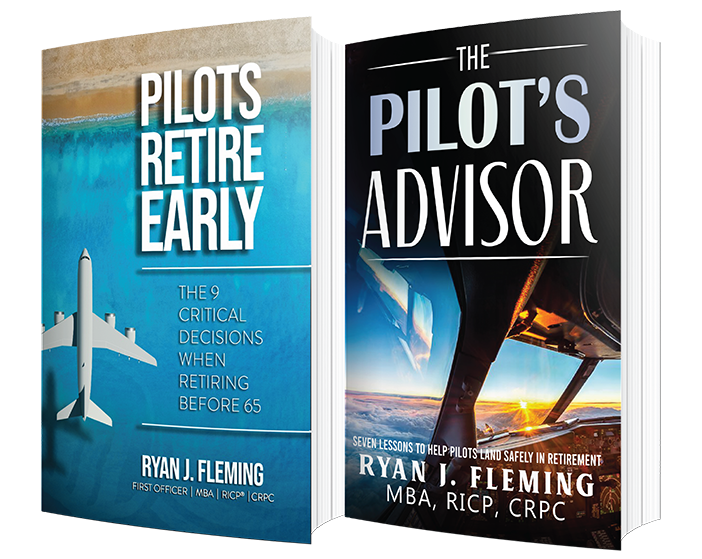
- Attention aviators, when you’ve spent years in the cockpit managing the complexities of flight, isn’t it time you navigated your retirement with the same precision? Introducing retirepilots.com right at your touchdown zone on our homepage, there’s a beacon flashing. Get my free toolkit. Click that and you’ll be cleared for a direct route to Ryan’s retirement toolkit, tailor made for pilots like you, Inside, you’ll find two of his important works, the pilot’s advisor and pilots retire early. Between these two books, you can decipher the nine critical decisions when retiring before 65 and discover the seven lessons to help pilots land safely in retirement. But that’s not all. This toolkit is packed with altitude high value, including extras to get your retirement plans off the runway and light the afterburners on your 401 k vector on over to retirepilots.com to grab your toolkit, and let’s embark on this journey together. We’ve got one more search to cover, but before we hit it, I want to tell you a funny story, Ryan, it has to do, you know a non pilot here, right? But know some pilots, obviously, through you got some pilots in the family. And also I get to fly a variety of planes over the years, through when I worked in in basketball and traveled with the athletics team at UNC, all around the country, got exposed to some different types of planes. And more recently, and over the last couple of years, I go to visit my parents in Maine, where they retired to and often I’ll fly Cape Air, you know, the smaller, I guess regional. Do they let you fly?
Ryan Fleming 11:54
Or do you just load the bags for them? I can,
Walter Storholt 11:57
I can reach the sticks from where I’ve sat, you know, like I’m hugging the pilot.
Ryan Fleming 12:02
What would TSA think about that? You know, you don’t have the open cockpit concept, like back in the day, I know, right?
Walter Storholt 12:09
But what an eye opening experience to go from big airplanes right now to a smaller jet or like, yeah, I guess they’re a type of Cessna, is what they typically fly. And what very cool experience, first of all. But it was really neat, because on one of the flights, I guess they were doing some training with one of the pilots. And it was just so neat, because it didn’t seem like anything was automated, right? Like, it seemed like he was flying the plane the entire time from Boston to Augusta or Rockland or wherever we were going, and they were just like pointing at things like, Yeah, over there. Okay, yeah. And turn here, like, oh. And now you see this down here. Now he might have just been showing him, like, something, some cool sailboat or something, but it seemed like he was saying, like, No, this is the angle of approach we want to take. This is, it was just neat to see all that kind of manual decision making and flying, rather than everything just being automated. So I don’t know if you, if you’re, if you’re tired of the automation, right? Maybe you go and you fly some some smaller planes for a different airline for your last couple of years, and enjoy that. If that’s what really you want to get back to doing, I think, I think
Ryan Fleming 13:09
that’s a dream for a lot of airline pilots, where they they retire from that legacy carrier lifestyle, and then they still want to go fly, go fly in the islands and the Virgin Islands or the Bahamas, and get back into GA flying, because it it brings you back to the passion that got you there before. I mean, I think many of us get to the point where we’re, you know, it’s what pays the bill. So we’re just a bus driver, driving, driving people or boxes around, and you lose that passion for your job. So absolutely, I think there’s a lot of options that are out there outside of the you know, like a security or lifestyle, kind of like, it’s kind of like working at Walmart and being a Walmart
Walter Storholt 13:49
greeter, right? I guess I don’t know about that connection necessarily, but you get face time. You get to talk to people. I mean, I get what you’re saying. It’s funny, because
Ryan Fleming 13:59
I can very much relate to what you’re talking about. I’m trying to think of the last one I did. Last one I did like that. And I want to say it was a guy flying us from somewhere in Florida down the Key West like it was like a little bubble pop over or, yeah, or maybe I can’t remember, but yeah, I definitely remember that, like sitting there going, Oh, look, he’s closing the door. The pilot was putting the bags on for the passengers. He had to actually close the door behind him and then go sit down and then fire up the jet, which, you know, obviously that’s not the way it works and in in our career field. But yeah, it was interesting.
Walter Storholt 14:31
I really enjoy the Cape Air flight. So shout out to Cape Air. Any pilots there? Big fan here, and appreciate what you guys do. Last but not least, final search. And this is the big one, Ryan, can AI actually help me plan my retirement better? And here’s what’s funny about this, all the fears, all the worries about AI, and I feel like there’s like some some hate for AI, right? Yet, a recent Invesco survey found that 55% of retirement savers said they would trust an AI powered tool more than. A family member to manage their retirement investments. And that’s a striking number in a few ways, one, because of the level of trust, despite all of this, like, hesitation over AI. But two, I actually take that as a good thing that people are willing to, like, say, oh yeah. Maybe my family member doesn’t know everything. Maybe my friend doesn’t know all the stuff. Let me verify. Let me check this with this AI powered tool. Maybe that’s actually a good development in the world of, like, you know, ranking opinions and trust values.
Ryan Fleming 15:25
I’d agree with that. That’s better than cousin Eddie, right? Or Uncle Joe. Uncle Joe says this. So that’s fact, or, or unfortunately, pilots in the cockpit talking at cruise and, you know, back and forth, and they’re all experts. I mean, I get a ton of questions, because pilots talk about finances all the time, sure, I think the good part is there’s more education out there, because they’re asking questions, and you can pull all this data all at once and get some some better conversations that are actually going on. So yeah, I do. I do think it definitely has a place in this. The hardest part about investing is the human element. I mean, that’s where it gets in the way, right? So the emotion, or it kind of reminds me of also, like, when you start looking at AI with with investing and finances, it’s like, web, MD, you know, like, like, Oh, my leg hurts, or my eyes this, and people go out have cancer, yeah. And that’s the way it is. It’s like, there’s so much information down there, but you can get pigeonholed down. You can basically get it to tell you whatever you want.
Walter Storholt 16:29
It to tell you, it will agree with you, and it will be like, yeah, totally smart about the way you’re thinking about this, even if it should be saying You’re an idiot. Don’t do that,
Ryan Fleming 16:41
and how you frame the question, and how you do it drives everything.
Walter Storholt 16:45
Yeah, yeah. You we have to realize, at least for now, AI pretty much always paints things with that kind of like rose colored glasses on right, like it’s, it’s gonna always think that you’re smart, you’re doing a great thing, validate your feelings, all the stuff. And that’s not necessarily what you need in a therapist or a coach or a financial advisor,
Ryan Fleming 17:04
and that’s what’s scary too, because AI can actually start learning your personality, and you want to let it so it knows your background a little bit more, because then it can maybe give you more direct answers. But there’s people out there that are talking to AI instead of talking to people, and that’s like their best friend, yeah. I mean, think about that. They wake up in the morning. Going, hey, you know, and they start asking AI questions, and you’re having a conversation versus a real person. And, I mean, that’s, that’s getting real scary.
Walter Storholt 17:31
Yeah, it’s really interesting. Did you see the movie Interstellar years back? Think I did? Yeah. Matthew McConaughey, big, you know, going to save the world, kind of, in space, sort of thing. Great movie. Love it. But they have the robots in that movie, and they’re basically, like, very smart, AI, very humanistic, sort of, the robots that help them do tasks as they’re going about, and help them fly the ship and all the stuff, and they have conversations with them as if they’re, you know, a human, essentially. But there’s at one point where, like, you know, they make jokes, like the robots are making jokes. And there’s one point where Matthew McConaughey is like, what’s your sarcasm meter? He’s like, I don’t know. He’s like, Oh, it’s, it’s an 80% he’s like, let’s dial that back to 20. So I feel like we have to do that with AI sometimes if you’re going to rely on it so much, be like, Hey, be more truthful with me. Like be don’t be afraid to push back on me if you’re
Ryan Fleming 18:21
going to use it in those after you watch that, because I think that would be funny to see and
Walter Storholt 18:24
to see now, yeah, but that’s
Ryan Fleming 18:26
what’s scary though, too. Is what would At what point do that? Does the AI robots go No? Right? Where they just decide, yeah, I think I’m done with these humans. Let’s poison the water supply and kill them all overnight. Yeah?
Walter Storholt 18:38
Or, well, we’ll show them how to tank their portfolio and cause them financial ruin.
18:43
Jokes on you? Yeah, you’re doing great.
Walter Storholt 18:45
Definitely invest in Enron. Yeah. Please go for it,
Ryan Fleming 18:48
yeah, where you actually got to be real close with your AI computer or whatever it was, and then he somehow you upset him.
Walter Storholt 18:55
Yeah, instead of using you cheated on your AI and went and asked Claude a question, or Google’s a Gemini, right? And it finds out. It’s like, oh, forget you.
Ryan Fleming 19:05
And suddenly it transferred your whole portfolio to somebody else. Disappeared overnight, the jealous,
Walter Storholt 19:11
vengeful AI relationship. Yes, we live in a
Ryan Fleming 19:14
very, very scary world.
Walter Storholt 19:16
I don’t know how we got to that point here at the end of this episode, but I hope something in here was helpful for somebody, and if not, maybe it just made you chuckle a little bit. Long story short, I think there’s a lot of curiosity. I think there’s a lot of nervousness, obviously, about AI as well. I don’t think that’s going away. Keep asking the questions, just remember to ask them to humans in addition to the questions you ask AI and searches and things like that, to get some balance in there,
Ryan Fleming 19:43
trust but verify, multi levels of oversight, custodians protection like yeah, cover your bases for sure.
Walter Storholt 19:50
Yeah, let’s do that. If you got questions for Ryan, how AI is going to play into your retirement picture, specifically, or some other retirement financial planning question, don’t hesitate to reach out. Best way to do it is get your retirement toolkit. You can get that, of course, yeah, Ryan’s pointing it to his pilot’s advisor hat. Very nice. Good luck on the logo there. We’ve got the toolkit. You can order that. It’s got Ryan’s books. It’s got resources, guides, more information in it as well, and a free portfolio analysis, where you get to meet one on one with Ryan to talk about your specific plan, which is really what it’s all about, getting that custom guidance and advice. Ryan, thanks for the help. We appreciate it. The link for that toolkit, by the way, folks, is in the description of today’s show. Ryan, we’ll talk to you again soon. Adios, have a good one. You too, see everybody next time right back here on the pilots advisor.
Speaker 1 20:39
Information is for illustrative purposes only and does not constitute tax investment or legal advice. Always consult with a qualified investment legal or tax professional before taking any action.
This podcast episode is for educational and informational purposes only. The opinions expressed are those of the speaker as of the recording date and are subject to change. This content does not constitute personalized investment, tax, or legal advice. Please consult a qualified professional before making financial decisions.