Preview of what we’ll cover today:
📅 Social Security: Understand the challenges of choosing when to claim
📉 Investment Risk: Recognize the hidden dangers of playing it too safe
📊 401(k) Investments: Avoid chasing returns and overlooking diversification
💰 401(k) Rollovers: Understand the tax implications before moving money
🏦 Retirement Income: Turn accumulated savings into a sustainable paycheck
📋 Beneficiaries: Keep designations updated as life changes
🔄 Roth Conversions: Evaluate the long-term tax consequences
Subscribe On Your Favorite App:
 YouTube
 Apple Podcasts
 Spotify
 Amazon Music
 iHeartRadio
 TuneIn
More About This Episode:
For pilots, some of the biggest retirement decisions can look deceptively simply, until the financial and personal trade-offs come into play. In this episode, Ryan explores why planning for Social Security, retirement savings, and life after flying can be more complicated than it seems. He also discusses the challenges pilots face and why having a thoughtful plan matter. What steps can help make these decisions feel more manageable?
Go Deeper Into The Episode:
0:00 – Intro
1:44 – Social Security Decisions
4:06 – Trump Accounts
5:30 – Investment Risks and Inflation
7:32 – 401(k) Fund Selection
10:02 – Managing 401(k) Rollovers
12:50 – Retirement Income Planning
13:35 – Beneficiary Designations
15:14 – Roth Conversions and Tax Strategies
16:34 – Tax Strategies
17:21 – Work with Ryan
Resources:
Retire Pilots – https://retirepilots.com
Get your FREE Retirement Toolkit – https://bit.ly/3ZmZsaX
Pilot Tax – https://pilot-tax.com/
The Pilot’s Advisor Podcast is also on video. Watch & Subscribe on YouTube: https://bit.ly/3EIEBW2
Connect with Pilot-Tax: https://pilot-tax.com/
Episode Transcription:
(Note, this is an automated transcription. Please forgive any errors.)
Walter Storholt 0:04
Hey, welcome to the Pilots Advisor. I’m Walter Storholt, alongside Ryan Fleming. He is the Pilot’s Advisor, of course. We’ve got a great episode today. We’re going to cover a wide range of topics in a way, but we’re going to talk about some of the things that are they easier or harder than they look. You know, you might hear trying to execute something in the financial world or do something in the financial realm, and it may come with the idea that it’s kind of hard to do or easier to do. We’re going to see and kind of put them to the test with Ryan today and see if that’s truly the case, or some things not quite matching up with what the assumptions are about how hard it is in the financial world. So this will be fun to dive into. We’re going to hit on some other important things that are also timely happening, kind of right now in the financial world, and give you some good context on a lot of different things today. Ryan, good to be with you, my friend. How’s life treating you? Before we jump in,
Ryan Fleming 0:52
doing well, Walter. It’s always good doing podcasts with you, so enjoying that. We’re having a nice change to fall now, where it’s 40s at night and gets up to maybe the 70s during the day. So it’s just it’s one of my favorite times of the year. Oh, and there’s college football
Walter Storholt 1:08
and there’s football to talk about. Yeah, exactly. Always, always. Yeah, good stuff. Hey, even my Tar Heels, at least at the time of our recording, have are doing okay right now. So
Ryan Fleming 1:18
yeah, they’re squeaking out a couple victories here, which is good.
Walter Storholt 1:21
Couple here and there. You know, you got to learn to win the close ones and the tough ones, right? Yeah,
Ryan Fleming 1:25
I’m I’m excited about talk talk about some of the topics we’re going to talk about today because I just feel like you know decision making, emotions, behavioral finance in general is one of the most intriguing things. The the the you know pilot where pilots make mistakes when you bring emotion into
Walter Storholt 1:42
it. Yeah, well, this won’t exactly be rapid fire, but we’re going to walk through a couple of different topics, couple of different of these scenarios, and see are these financial moves as simple as they seem or not. And so we’ll hit a couple of different areas of the financial world here. So let’s just start off with an easy one, Ryan. Deciding when to take Social Security for pilots is this something that is easier than it seems or harder?
Ryan Fleming 2:06
I think this is one that’s getting harder and harder. Okay, we’ve done a couple reels out there talking about Social Security and whether you could just keep all that money and would you do it yourself? Yeah, versus paying into it, and of course, then some of the comments out there are quickly getting political. I used to think that this one was somewhat easy in the sense of I used to always say, “Tell me when you’re going to die, and then we can do the math equation and figure out what would make the most sense for you.” And I think some of that still applies. You know, if you have a client that doesn’t need the Social Security, they might want to delay it to get that bigger number to for later on, and or to protect their spouse. There is a cost of living adjustment with it, but where I think it’s getting really, really gray now, and it’s getting more, it’s it’s getting to be a harder and harder decision, is just the fact that the math doesn’t work anymore, and we know that Social Security is going to have to be changed or adjusted or reduced, just for the numbers to work. But when is that going to happen? How much is that going to reduce it? You know, what’s the and and so now you’re starting to make some assumptions and you’re starting to guess. And of course, when you don’t have clear defined numbers, objectives, it’s it’s it’s a tough tougher conversation.
Walter Storholt 3:19
Yeah, it’s kind of interesting. You know, kind of hidden in that cost of living adjustment announcement recently for Social Security was a little hint at one of the ways that they’re trying to make up that that gap in Social Security. Right? They think they announced a 3.6% for next year will be the increase in what people can, you know, the cost of living adjustment for Social Security. But kind of hidden in there was those of us who are still paying into the system are going to see something like a 4.8% increase in what we’re paying in those FICA taxes. So, and that gap, you know, helps them fund Social Security a little bit more. So, another example of where we’re we’re helping support that system a little bit more than those taking out.
Ryan Fleming 4:02
Well, the devil is always in the details, right? Well, and even even I’m I’m you know everybody’s talking about these Trump accounts, and I think it’s great. I think it’s fantastic that the government’s going to put $1,000 in a brand new child’s Trump account and let the money grow. Where they got it wrong is they made it into a traditional IRA, so that $1,000 that they put in, they’re forcing. They’re not forcing, but they’re helping somebody get invested in the market. It’s going to grow for the next 60 years, but then they’re going to tax it. See the problem with that? Like if they were truly trying to help people get ready for retirement and be in a better position to where Social Security wasn’t going to be a major part of their actual living expense, or you know what they live off of in retirement, why wouldn’t it be $1,000 that would grow like a Roth IRA and grow tax free forever? But no, there’s that that surprise at the end. So we’re going to grow that $1,000 into $2 million and then take 30% of it. So, I feel like we kind of missed out on that once again. So I always try to look at the motivation behind things, and so kind of like you’re talking about with the 3.6 cost of living adjustment. Oh, by the way, there’s the cost of living adjustment, but then you’re getting beat up today. Those that are still working. So
Walter Storholt 5:16
yeah, it feels like one of those kinds of things that’s better than nothing, but isn’t the most advantageous thing if you’re putting a little extra effort and thought into
Ryan Fleming 5:25
it. Yeah, one and and I’m going to divert from this since we’re talking about we talked about cost of living, we’re talking about inflation. I was recently reading an article and it was talking about how you know nobody nobody wants to lose money, right? Losing money hurts when the market goes down. It hurts even though we don’t need to pull from that while we’re still working, we we just don’t like it. And you know, when the market goes down, it actually creates an opportunity for you to buy stuff when it’s lower. And I think Warren Buffett has some great quotes on that. How he likes it when the market crashes and there’s blood in the streets because if you have capital on the sidelines, you can buy in while it’s low, right? And we all know to buy low, yeah. And we all know to buy low and sell high, but we just don’t do it. The emotions cause us not to do it. And this article I was reading was talking about how people are trying to invest their money that going low risk in your portfolio is actually way riskier than you think, and what it was talking about was yeah. If you invest in a portfolio that has more fixed income or bonds, it’s going to be a lot less volatile. But if you look at the end of the day, what you’re giving up by doing that long term is you might not have enough money to retire off of. So for the average investor that’s still in the accumulation phase, it’s very very risky to put your money in a low risk portfolio. It’s very risky for people to put all their money in like these high yield savings accounts, and you know people like them. They like CDs and they like high yield savings accounts because your money will never go down. But what you’re not realizing is you’re not even keeping up with inflation, so you’re really kind of kicking the can down the street, or even losing money to inflation. I like to talk about the analogy of you’re in a pool and you’re just treading water. Like, what’s the end game here? Because you’re not outpacing inflation, your money’s not growing, and and it’s going to affect you later on. Because if you can’t like get your money to grow and outpace inflation, you’re actually losing money.
Walter Storholt 7:24
Yeah, that’s a great point, and it’s one that we’ve got to make sure we’re talking about and bringing up, and know that you’re addressing it consistently with clients as we talk about things that are maybe harder or easier than they seem, especially for pilots. Let’s keep that context in mind. We’re not talking about the general public here, what about picking funds inside of your 401k or your work plans?
Ryan Fleming 7:47
Well, I think the problem that I see with this when people are doing it themselves, and a big problem I see is a lot of people are just you know picking a target date fund and leaving it there, which of course that’s much better than stock picking or you know doing things like that or
Walter Storholt 8:01
not investing it at all right
Ryan Fleming 8:03
yeah exactly so you know it’s not the worst case but people aren’t really good at building out a truly diversified portfolio that’s not just U.S. large caps S and p5 100 or stock picking because they want to invest in what they see every single day and that’s a small small part of the the market and not nearly diversified enough. I actually sent something out the other day that was talking about the S and P 500, where eight stocks make up like 44 of it right now. You know, it’s been the Mag Seven for a while. There’s a couple more that have broken out, but all those returns are with eight or nine companies, and the rest of them are actually not returning anything. So, how risky is that? Or having the discipline, if you build out a truly diversified portfolio that’s got mid cap, small cap, international, staying in that. And what I also see too is, you know, I always joke about how pilots want all of the upside and none of the downside. Well, what they do is they’ll look at a portfolio, and if that portfolio is not outpacing the S and p5 100 around this time of year or at the end of the year, it happens a lot in January. Then they’ll go chase what did well that year prior, whether it’s an ETF, mutual fund, S and p5 100, some you know tech’s a big thing right now, and so they’ll actually abandon their portfolio, the system that they signed up for, and move all their money to that thing that did well last year, and the actual possibility of that thing outperforming again is actually low, because for the that same ETF or or benchmark to do the you know be the top performer year after year doesn’t happen. It’s just not the way it is, so you end up watching a lot of clients chase returns, and the net effect of that is they end up hurting themselves.
Walter Storholt 9:47
Yeah, it’s kind of interesting how that is what leads us to do that emotionally, and then also just the behavior that kind of leads to that follow through. Then the following year, and can get you in a lot of trouble. So yeah, let’s be very careful of all those kinds of things. Something else on the list here, Ryan, would be 401k rollovers. First of all, how often are you doing those for pilots? And then the kind of question of the day is: is that easier or harder than it seems?
Ryan Fleming 10:14
Well, it’s probably a little bit harder than it seems. And I think when you look at something like this, you need to address all the implications of it in most cases, rolling out of a 401k plan is going to give you a lot more diversification on how to invest your money. But you need to look at fee differences and and being outside of that four 1k plan. So there’s a lot that goes into it. I see this a lot more when somebody retires, of course, from their airline. They’ll want to roll their four 1k out into a Roth IRA and an IRA and outside their company’s business plan, which you know I’m fully supportive. I just want my clients to all understand the implications of that. Or another case that happens is if someone’s flown for some other airlines and they have a bunch of 401ks hanging out there, consolidating those is a big thing. And the only way to do that is doing a direct rollover into an IRA where you have a little bit more control. So, just making sure you understand what you’re doing. Make sure you’re doing a direct rollover so that’s having no tax consequences. I recently had someone reach out to me, and they had actually gotten checks rolled over from their old airlines, but they hadn’t put him put him anywhere. And of course, if you do that and you hold on to it for an extended period of time, then it’s considered a distribution, and you’re going to have all the tax implications, a 10% penalty, whatever. If you don’t get that back into a qualified retirement plan, so just make sure if you’re doing any of these things, you’re working with a financial advisor, you’re working with somebody that understands what’s what you’re actually doing, so you don’t have any surprises on the other end.
Walter Storholt 11:47
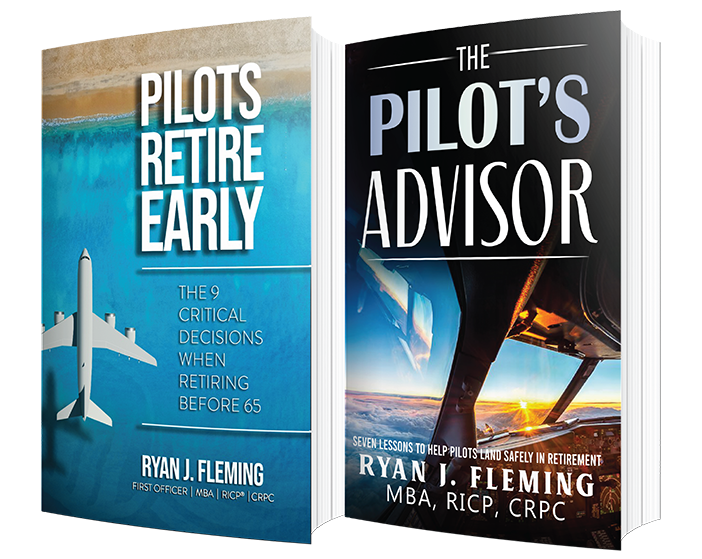
Attention, aviators! When you’ve spent years in the cockpit managing the complexities of flight, isn’t it time you navigated your retirement with the same precision? Introducing RetirePilots.com, right at your touchdown zone on our homepage, there’s a beacon flashing. Get my free toolkit. Click that, and you’ll be cleared for a direct route to Ryan’s retirement toolkit, tailor-made for pilots like you. Inside, you’ll find two of his important works: The Pilots Advisor and Pilots Retire Early. Between these two books, you can decipher the nine critical decisions when retiring before 65, and discover the seven lessons to help pilots land safely in retirement. But that’s not all. This toolkit is packed with altitude high value, including extras to get your retirement plans off the runway and light the afterburners on your 401k. Vector on over to retirepilots.com to grab your toolkit and let’s embark on this journey together. Ryan, speaking of retirement, what about for when pilots get to retirement and they’ve got to turn all of this savings into a retirement paycheck? Is that something that’s easier or harder than it seems.
Ryan Fleming 13:01
I think that’s much harder than it seems. I think the pilots know they have to save for retirement, but they don’t really understand how complicated the distribution phase is and how to come up with a proper retirement income plan to cover your costs. and And basically, here’s the pot of money that whether you know pensions, social security, and then how much you saved. How do we put that into your daily, you know, living expenses. How do how do you not run out of money? How do you evaluate that? How do you constantly analyze that with the up and down markets? I think that that’s where you really really need a financial advisor and have a plan and and make sure that you’re doing it in a way where you’re not going to run out of money. Tidbit for today that I really want to get out there is something that we don’t think about that often until bad things happen. Right now, every year, look at your your beneficiaries. When’s the last time you really looked at your beneficiaries? When’s the last time you updated them? Do you even have secondary beneficiaries? So, in many cases, a lot of the accounts that people have, their primary beneficiary would be their spouse, which is fantastic. Okay, that’s great. But have you ever thought about what if something happens to you and your spouse at the same time? I mean, how much do you travel together? How much do you guys drive together? So these things do happen, and you know, so some steps to take having secondary beneficiaries and or taking the next step to have a trust, so that one thing that could happen, your money is still protected, safe from being taken from the government, or just be hanging hanging out there because there isn’t a beneficiary. I’ve even seen things as bad as it’s happened is somebody that has got gone through a divorce 1012 years ago, and guess who was the only beneficiary on their 401k,
Walter Storholt 14:41
yeah, still that ex
Ryan Fleming 14:43
that ex spouse. So, so these are things that you want to think about, that you want to update any life changes, and you know, new baby, new marriage. Look at your beneficiaries because it’s going to save you a lot of headache in the end.
Walter Storholt 14:56
Yeah, that’s a big one, and that that’s one that’s easier. Than it seems like that’s an easy thing to do to update your beneficiaries, right? It’s just paperwork and quick paperwork at that most of the time, but that’s one that has huge consequences if you don’t do the easy thing or the easy check-in. So glad you brought that one up. Maybe one or two more here, Ryan. What about a Roth conversion? Are you doing those with pilots, and is that easier or harder than it seems, or same category as those 401k rollovers.
Ryan Fleming 15:22
Well, I think that that’s a really difficult conversation when you’re actively working. Should you be doing Roth contributions? Should you be doing a Roth conversion? And this is a quite a bit different for pilots because very few professions out there are putting 1819, 20% of everything you make into a 401k that’s all tax deferred. So a one-on-one conversation about required minimum distributions, having a plan for that, little things that you might tweak inside your 401k today, so that you’re in a much better situation down the line. A 30 or 40 year old might want to go ahead and pay the government to go away and get some Roth money in there, whereas it might not make as much sense for somebody that’s near retirement, but in many cases, a Roth conversion. Looking at those, most people are doing that from the time they retire to RMD age because you should be in a lower tax bracket. But some aren’t. I mean, if you have a military pension and a you know pension that some airlines still offer, you might be in the exact same tax bracket you are now. So, looking at the compounding interest growth of money over time, tax free. These are all conversations that we want to talk about and should talk about one on one because there are some gray areas. And lastly, something I’ll give a little tidbit out there because we’re going to have an episode coming up here real soon. I keep getting asked about tax strategies all the way, all excuse me, all the time. Most airline pilots are highly compensated; they’re w2 income. There’s not a lot they can do, so we’re going to actually talk to some people that do some tax strategies that can help out with some of these things. I’m not a CPA; I don’t give tax advice, but I can have them on my podcast, and I’ll even refer you to them if you want to talk to somebody that specializes in stuff like this. So you can have some options on maybe having a better tax strategy.
Walter Storholt 17:09
Yeah, excellent. Well, we look forward to that episode and the conversation, and that’s a great one to end it on. So there you have it: a few financial moves that are as simple as they seem sometimes, but sometimes not. And sometimes it’s the paperwork that’s simple, but it’s the conversation that leads to the paperwork. That’s the hard part. That’s where you’ve got to really come to the conversation with what you’re looking for in retirement, knowing what you want, diving deep, asking the hard questions, and that’s what Ryan helps people do each and every single day when he’s meeting with them across the country. So, if you are a pilot, you’re looking for financial guidance for retirement planning help. Ryan is here as the pilot’s advisor to help you out. Best way to start is to order that toolkit in the description of today’s show. You’ll find the link there. It’s a free toolkit that you’ll get, and it comes with that free portfolio analysis where you can meet one-on-one with Ryan. So check all of that out, and you’ll be well on your way to a better financial plan going forward. Ryan, thanks for the help this week. Good thoughts, and we’ll look forward to the next one.
Ryan Fleming 18:08
As always, Walter, thanks for your time. Want to help pilots out there? So give us a call, order the toolkit, and we’ll talk to you next time. You ready, Walter? Positive rate.
Walter Storholt 18:17
Gear up.
Ryan Fleming 18:18
All right. We’ll check the misapproach altitude. We’ll talk to you guys next time.
Speaker 1 18:26
This episode is for educational purposes only and is not individualized investment advice. The Pilots Advisor LLC is an SEC registered investment advisor. Registration does not imply a certain level of skill or training. Past performance is not indicative of future results, and investing involves risk, including the possible loss of principal.
This podcast episode is for educational and informational purposes only. The opinions expressed are those of the speaker as of the recording date and are subject to change. This content does not constitute personalized investment, tax, or legal advice. Please consult a qualified professional before making financial decisions.